Global equity analysis of how climate pledges stack up against the Paris Agreement goal of limiting warming to 1.5°C
New report released at COP30
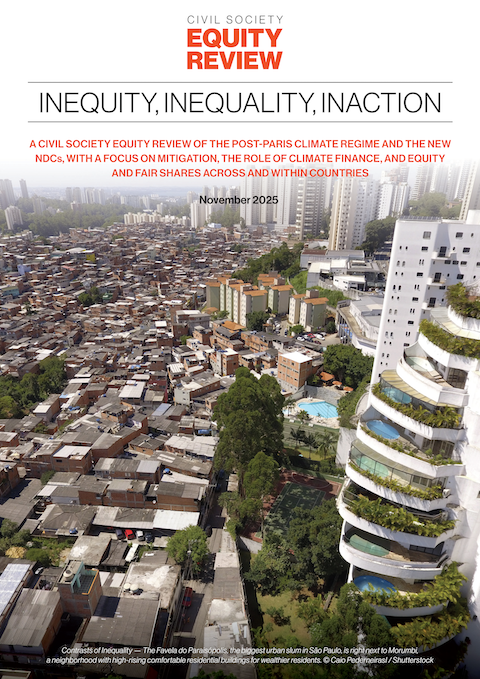
Inequity, Inequality, Inaction
A Civil Society Equity Review of the post-Paris climate regime and the new NDCs, with a focus on mitigation, the role of climate finance, and equity and fair shares across and within countries
The 2025 Review finds that major Global North countries have failed to cut emissions while simultaneously expanding oil and gas extraction and are not delivering public climate finance at anything close to fair-share levels or the scale needed to support transformation in the Global South.
Their failure to cut emissions and provide finance is driven not by ignorance but by entrenched interests — oligarchs and fossil-fuel lobbies holding politics in a chokehold, spreading disinformation, and paralysing democracy.
We also find that while the Global South is closer to meeting its fair share, it still needs to take more effective climate action but is all too often held back by lack of funds and excessive levels of debt.
This year’s analysis connects the dots between inequality, debt, and power - showing that climate failure is not a technical shortfall but a systemic injustice. It traces how elite capture, debt, and disinformation are paralysing cooperation - and sets out what COP30 must deliver to restore justice and trust.
The report also warns that inequality within countries is driving the crisis. The 2025 Review calculates national fair shares by adding up individual responsibilities – meaning the richest, wherever in the world they may be living, have the largest obligation. The global rich can shield themselves from many climate impacts while pushing the costs of transition and disaster onto workers and overstretched public systems.
Building on previous Civil Society Equity Reviews, the 2025 report includes:
A qualitative and quantitative assessment of emissions trends since the Paris Agreement, showing unmistakable continuity with longer-term patterns: the most historically responsible countries continue to accrue massive mitigation shortfalls relative to their legal and moral obligations.
An analysis of the latest NDC submissions, revealing no meaningful turnaround. They do not indicate significant increase in emissions cuts by Global North countries.
Evidence that responsibility for these shortfalls is deeply unequal within countries. The richest individuals have far higher per-capita emissions and far larger mitigation gaps than national averages reflect.
A demonstration that these failures are rooted in the structural injustices and inequalities that define today’s world. These conditions empower fossil-fuel corporations, enable obstructionism, and systematically block the climate transition.
The need for fair-shares NDCs with real finance and fossil-fuel phaseout, a finance reset that replaces debt and loans with public, grant-based support, and just-transition frameworks that centre workers and frontline communities. These shifts must break elite capture through progressive taxation and global reforms, and redirect resources toward peace, democracy, and strong public systems.
“The failure to reduce emissions and provide adequate climate finance is widely recognized but has too rarely been identified as the fault of elites, who reside predominantly in the countries of the Global North. The grotesque appropriation of wealth and power by this group, in particular the ultra-rich, has helped them keep a tight leash on political decision making and public policy. The fossil fuel industry, in particular, has captured crucial political processes, sowing disinformation and leveraging public fear to protect its interests.”
A Decade of Equity Reviews
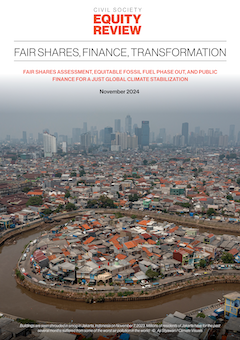
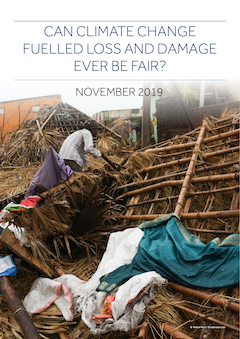
In the period leading up to the 2015 Paris climate summit, we came together to conduct a civil society equity review of the emissions reductions pledges that countries were putting on the table there; over 150 organizations endorsed our review. Since then we have released a series of major reports at each of the UN Climate Talks – analysing whether the climate commitments, finance pledges and fossil fuel phase out plans that Parties had promised are ambitious enough and tolerably fair.
Since 2015, over 600 distinct organizations have endorsed our reports.
Click on a report below to download.




Who we are
As social movements, environmental and development NGOs, trade unions, faith and other civil society groups, we have come together to assess the climate commitments that have been put on the table through the UN climate negotiations.
We seek to identify which countries are offering to do their fair share, which need to do more, and present recommendations on how to close the emissions gap.

Are countries Doing their
Fair Share?
This video explains the assessment methodology that is used by the annual Civil Society Equity Reviews in our assessment of whether countries climate action pledges are consistent with their fair share of global climate action.
Join now
Use the form below to sign on to the Civil Society Equity Review as an organisation